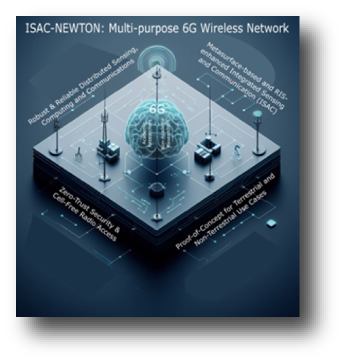
-
Self-Supervised Learning for CSI-Based Localization in ISAC
Summary Wireless networks routinely estimate how signals propagate between devices and base stations. These channel estimates can also support localization. Self-supervised learning can make use of large collections of channel measurements and reduce the number of reference positions that need to be surveyed. How channel estimates reveal location Channel state information (CSI) describes how the…
-
DC15 Position Reopened
A funded doctoral position at the University of Huddersfield, UK, is available.🔬 Research topic: Metasurface-enabled synthetic aperture radar installed on UAVs.The research combines metasurface design, radar technology and machine/deep learning to improve UAV-based imaging, target detection and classification.https://www.linkedin.com/feed/update/urn:li:activity:7511363960198172672/https://euraxess.ec.europa.eu/jobs/326102https://isac-newton.eu/jobs/dc15/📅 Application deadline: 9 October 2026⏳ Contract duration: Up to 27 months
-
Special Session at EuCNC 2026
The special session “Redefining Connectivity: Multidisciplinary Approaches to 6G through Ultra-Massive MIMO and Intelligent Sensing” has been selected for the EuCNC & 6G Summit Conference, which will take place in Málaga from 2 to 5 June 2026. It is jointly organized by ISAC-NEWTON together with other projects such as MiFuture, Passionate and ENCORE6G.
-
ISAC: A Technical Overview with RIS
Integrated Sensing and Communication (ISAC) aims at the joint design of wireless communication and sensing functionalities within a single system, reusing the same hardware, spectrum, and signal resources. Instead of treating communication and sensing (e.g., radar or localization) as independent subsystems, ISAC formulates both as coupled signal processing tasks that operate on shared waveforms and…